When comparing mattress materials, memory foam and latex are often placed in the same category. Both can provide pressure relief and body support, but they achieve these results in different ways.
Memory foam contours closely to the body and responds slowly to pressure. Latex, by comparison, usually feels more buoyant and responds more quickly when pressure changes. These differences affect comfort, motion isolation, temperature management, product weight and overall mattress construction.
For mattress retailers, wholesalers, furniture brands and hospitality buyers, understanding the difference between a memory foam vs latex mattress is useful when selecting materials, developing product collections and comparing manufacturers. The right choice depends not only on how a mattress feels, but also on its material composition, specifications, target market and price positioning.

memory-foam-vs-latex-mattress-comparison
Memory foam is a type of viscoelastic polyurethane foam. Manufacturers formulate it with specific additives and processing methods to create a material that responds to pressure and temperature.
When someone lies on a memory foam mattress, the foam gradually conforms to the body's shape. But after the pressure is removed, it takes time to recover its original form. This slow response creates the familiar sinking or body-hugging sensation associated with memory foam.
Body contouring: Memory foam adapts closely to body curves, helping distribute pressure over a wider contact area.
Motion isolation: Its energy-absorbing structure can reduce the movement transferred across the mattress. Thus, this feature is often valued in mattresses designed for couples or hospitality environments.
Slow recovery: Memory foam does not bounce back immediately. Because the recovery speed varies according to the foam formulation, density, temperature and construction.
Different comfort options: Manufacturers can adjust foam formulations and layer designs to create different firmness levels and comfort profiles.
For buyers, it is important to distinguish between foam density and firmness. Density measures the mass of foam per unit volume, while firmness describes how the foam responds under a specified load. Two memory foam layers with similar density can still feel different.
A latex mattress uses latex foam as one or more of its comfort or support layers. Latex foam can come from natural rubber, synthetic rubber or a blend of the two. Therefore, the term "latex mattress" does not automatically mean that the product contains 100% natural latex.
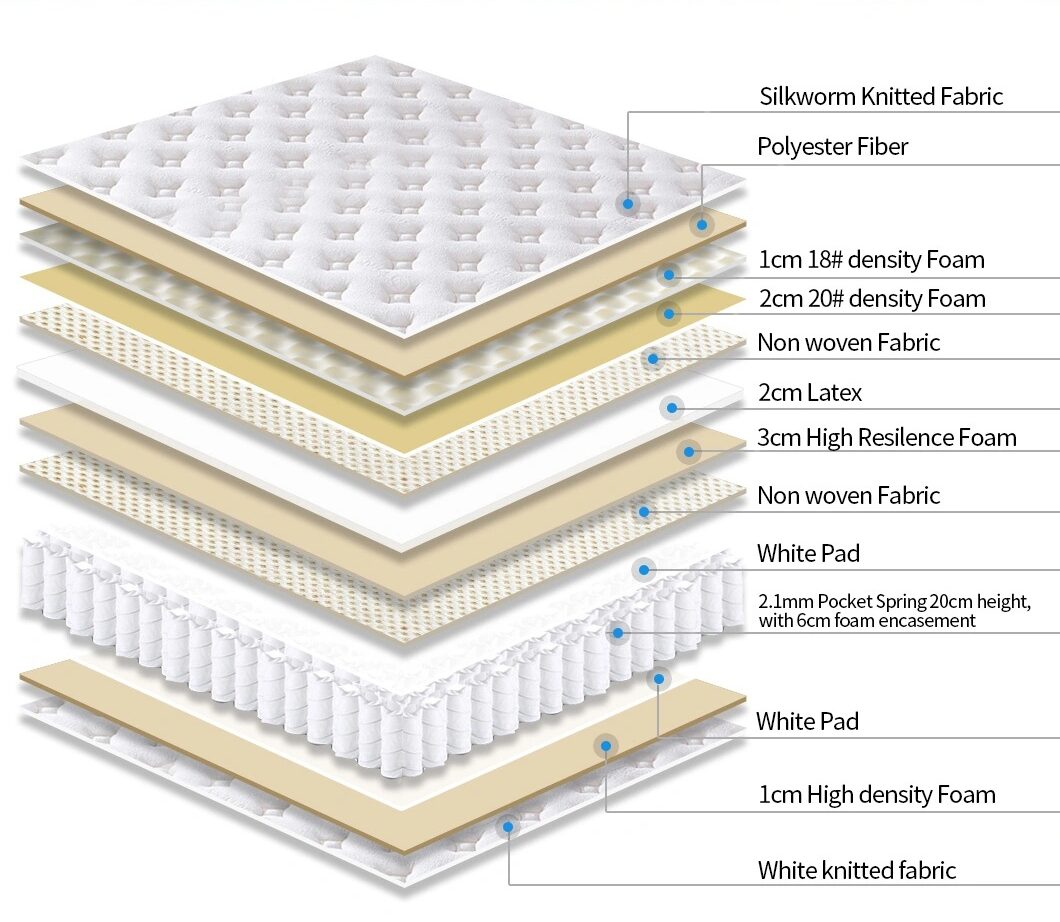
Natural latex comfort layer in a multi-layer mattress construction
Natural latex: Produced using natural rubber harvested from rubber trees. Its composition and processing determine the final material properties.
Synthetic latex: Made using synthetic rubber compounds. It can provide an alternative at a different material cost and performance level.
Blended latex: Combines natural and synthetic latex. The actual ratio should be confirmed through the supplier's material specification rather than inferred from the product name.
Natural latex foam is commonly produced using two processes: Dunlop and Talalay.
Neither process automatically makes a mattress better. Therefore, buyers should compare the actual firmness, density, layer thickness, composition and test information of the finished latex material.
Responsive feel: Latex generally returns to shape faster than memory foam, creating a more buoyant surface.
Pressure distribution: Latex can adapt to body contours while maintaining a more lifted sensation.
Airflow: Its foam structure and perforation design can support airflow. The mattress cover, layer thickness and overall construction also affect temperature performance.
Resilience: Latex is known for its elastic response. Its long-term performance still depends on the latex formulation, material quality and how the mattress is constructed.
The most useful way to compare these materials is to look at how they perform in a finished mattress rather than relying on the material names alone.
| Comparison | Memory Foam | Latex Foam |
|---|---|---|
| Material base | Viscoelastic polyurethane | Natural rubber, synthetic rubber or a blend |
| General feel | Contouring, body-hugging | Buoyant, responsive |
| Pressure response | Slow response | Faster response |
| Recovery | Gradual | Usually quicker |
| Motion isolation | Generally very good | Can transfer more movement due to higher rebound |
| Airflow | Depends on cell structure and formulation | Often good, depending on structure and design |
| Pressure relief | Conforms closely to body shape | Combines contouring with a more lifted feel |
| Weight | Varies by density and construction | Often heavier at comparable dimensions |
| Material cost | Wide range of price levels | Natural latex often carries a higher material cost |
| Composition | Polyurethane-based formulation | Natural, synthetic or blended rubber |
These are general material tendencies, not guaranteed performance results. For example, foam formulation, density, firmness, layer thickness, mattress cover and support-core design can all change the final feel.
Memory foam is often selected for mattresses that provide a close-fitting, enveloping sensation. It gradually adapts to the sleeper's shape and can reduce concentrated pressure at contact points.
Latex also conforms to the body, but its faster recovery usually creates a more buoyant feeling. Rather than sinking deeply into the material, the sleeper may feel more supported near the surface.
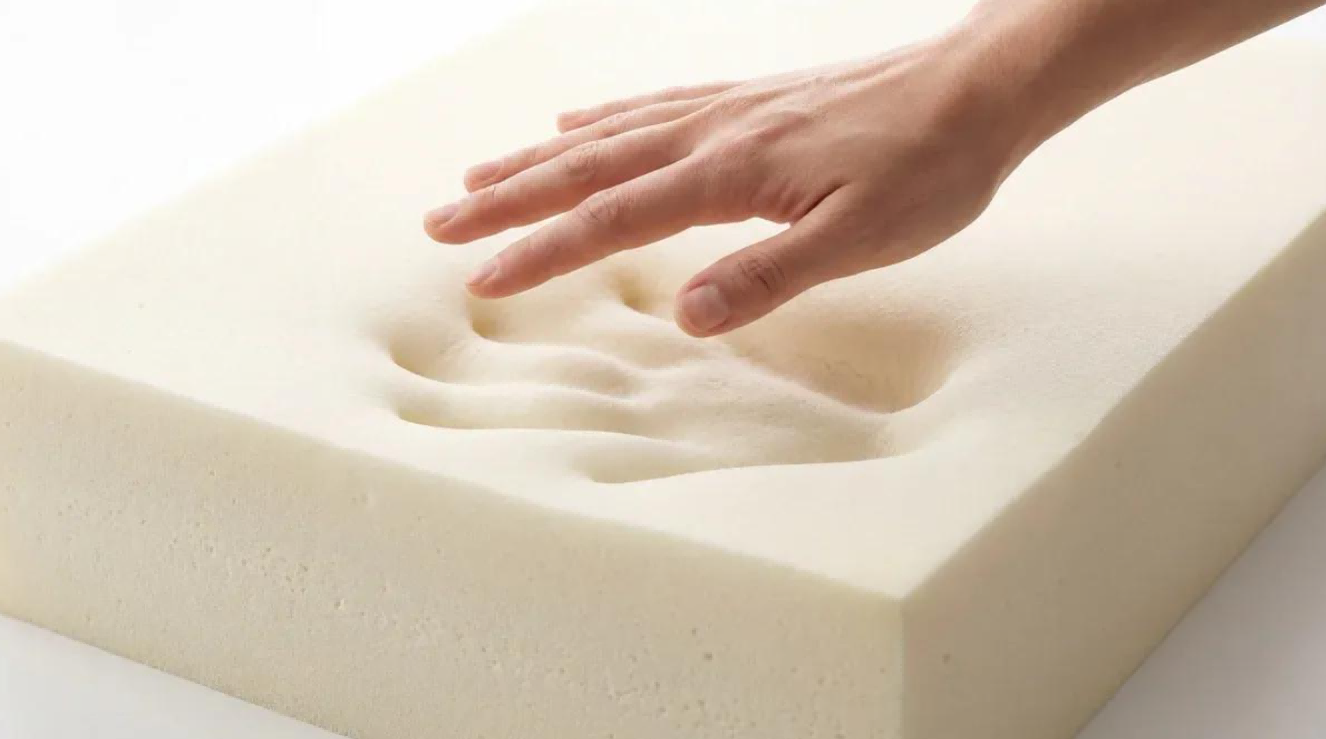
Slow recovery response of viscoelastic memory foam(1)
For product development, the distinction matters. A mattress designed around deep contouring may use memory foam as a major comfort layer. A model intended to feel more responsive may use latex or combine latex with other foam layers.
Neither material should be evaluated as the mattress's only source of support without considering the full construction.
A comfort layer influences how the mattress responds at the surface, while the support core plays an important role in maintaining the overall structure. A memory foam mattress may use polyurethane support foam beneath the comfort layer. A latex mattress may use latex throughout or combine latex with other support materials.
For wholesale and OEM projects, buyers should review the complete layer specification instead of comparing only the top foam.
This is one of the clearest differences between the two materials.
Memory foam absorbs movement and generally transfers less motion across the sleeping surface. Its slower recovery can also make position changes feel less immediate.
Latex responds quickly when pressure is released. This makes it easier for many sleepers to change positions, but the additional bounce may allow more movement to travel across the mattress than in a comparable memory foam design.
The best option depends on the intended product positioning. Motion isolation may be a priority for couples, while responsiveness may be more important for customers who prefer an easier-to-move-on surface.
Traditional memory foam can retain more body heat than some other foam types. However, modern formulations may use open-cell structures, gel additives or other design features to manage heat.
Latex foam often has an open structure, and some latex layers include perforations to encourage airflow. Even so, a latex mattress is not automatically cool in every situation.
The mattress cover, quilting materials, foam thickness, bed base and room environment all influence temperature. Buyers developing products for warmer markets should evaluate the complete mattress rather than making cooling claims based on one material alone.
Both memory foam and latex are available in different quality levels. A higher price or a material label does not guarantee longer service life.
A useful way to evaluate durability is to request relevant material test data and understand how the manufacturer checks the finished mattress for deformation and structural consistency.
There is no single winner for every mattress project. The more practical question is which material best fits the product's intended users, price level and construction requirements.
When we organize the hotel and hospitality projects, material selection should be based on the complete mattress specification and the operating requirements of the property.
Procurement teams may need to consider:
Memory foam and latex can both be used in hospitality products, either as individual comfort layers or as part of a hybrid construction. The best choice depends on the project's comfort brief, budget and maintenance requirements.
For mattress wholesalers, furniture brands and OEM/ODM buyers, a material name is not a complete specification. Before confirming a bulk order, request technical information that allows the product to be evaluated and reproduced consistently.
Ask for the density and firmness specifications of each foam layer. Should record separately if these are different properties.
For memory foam, confirm the density, firmness, recovery characteristics and intended application. For latex, confirm the material type, density, firmness and whether the foam is natural, synthetic or blended.
If a product is marketed as natural latex, ask the supplier to clarify its composition and provide supporting documentation where relevant.
Do not rely on terms such as "natural feel" or "eco-friendly latex" as proof of material content. Product claims should match the actual formulation and available evidence.
A mattress's comfort depends on how its layers work together. Therefore, request a construction diagram or bill of materials that identifies:
This information helps buyers compare products on an equal basis and reduces misunderstandings during sample approval.
For products that may be compressed or roll-packed, confirm whether the foam and complete mattress construction are suitable for the selected packaging method.
Ask about recovery behaviour after unpacking and any recommended recovery period. Packaging compatibility should be confirmed for the specific model rather than assumed from the foam category.
The quality of a mattress depends on more than the foam supplier. The manufacturer must also select suitable materials, control layer dimensions, assemble the mattress correctly and inspect the finished product.
When evaluating a mattress manufacturer, consider asking:
A dependable supplier should be able to explain why a particular material and construction are suitable for the project, not simply recommend the most expensive option.
Memory foam is a strong option for designs that prioritise body contouring, pressure distribution and motion isolation. Latex is often preferred when the product calls for faster response, resilience and a more buoyant feel.
For buyers, the decision should come down to the complete specification: material composition, density, firmness, layer thickness, support-core design, target price and quality requirements.
Neither material is universally better. Latex generally offers a more responsive and buoyant feel, while memory foam provides closer contouring and stronger motion isolation in many designs. The better option depends on comfort preference, product construction and budget.
No. Memory foam is a viscoelastic type of polyurethane foam. Latex foam is made from natural rubber, synthetic rubber or a blend of the two. They are different materials with different response characteristics.
Memory foam is available across a wide range of prices. Natural latex often costs more because of its raw materials and processing, while synthetic and blended latex may have different price levels. The final mattress price also depends on construction, thickness, cover and other components.
Yes. A mattress can combine latex and memory foam in different layers to balance contouring and responsiveness. Design the layer order, thickness, and firmness to achieve the intended comfort and support profile.
Review material composition, density, firmness, layer thickness, construction drawings, relevant test documents, sample approval procedures, packaging compatibility and bulk-production consistency. These details provide a clearer basis for comparing suppliers.
About Shangrou
For mattress sourcing projects, clear material specifications and product requirements are the starting point for a successful manufacturing discussion. Contact Shangrou to share your target market, mattress construction, material preferences and order requirements.
Our team can then discuss the product details and the information needed to evaluate a suitable mattress solution.


 Chinese